Introduction
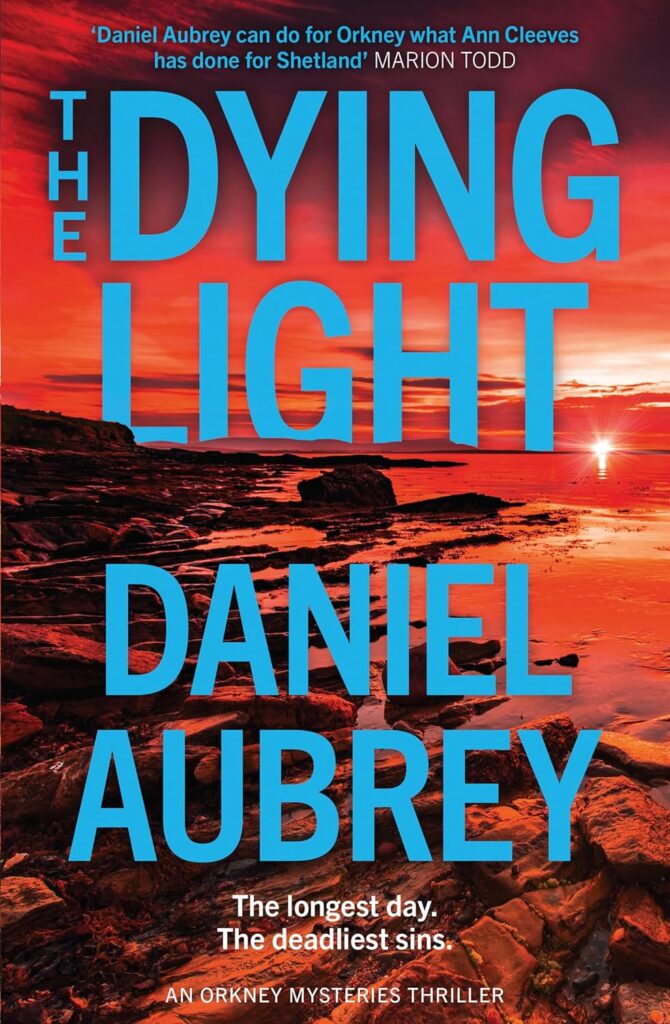
The Dying Light is a crime novel written by Daniel Aubrey, an English author living in the Orkney Islands off the coast of Scotland. Daniel was interviewed at the Jericho Writers’ London Festival of Writing in June, and I won a signed copy of the novel in a lucky draw at the event. It’s a crime novel and Book 2 in the Orkney Mysteries series, featuring journalist Freya Sinclair and Detective Inspector Fergus Muir.
What the Book is About
There’s a lot going on in this novel. A body is found in a remote location. Police can’t immediately identify the body, and one of the detectives suspects he might have been murdered. Freya Sinclair is investigating police corruption and DI Fergus Muir is helping her. The disappearance of a teenage boy in the nineties is eventually (possibly) linked to this man’s death. It’s difficult to tell you more about the novel without giving any spoilers – even the book’s own back cover doesn’t say much more than this.
What Worked for Me
I love the easy, plain writing. The author isn’t trying to be clever with his writing and when he does use some regional terms like ‘peedie’, it’s easy enough to take their meaning from the context of the sentence.
The Orkney Islands are foreign to me and I enjoyed the descriptions of the light, the landscape, and the sea. Because of his English accent, I assume Daniel Aubrey was raised in England, so Orkney was at some point new and foreign to him as well. I think it’s because of this that he describes the sorts of things that he found new and exciting when he first went to live there, and which are the sort of things that interest a reader like me. A writer who grew up there might not have thought to describe the near-midnight sunset, or the biting wind, or the attitude of the locals towards mainlanders.
Something I’m forever pulled up for in my own writing is that I don’t describe my characters’ actions enough. I forget to let them take a bite from their sandwich, or be annoyed by a random sound, or smell the salt on the air. This book does it in spades.
Magnus turned in his chair, looked out across the Peedie Sea with his fingers steepled beneath his chin.
These small gestures help us readers picture the scene, and it helps us see how the characters interact with these scenes and with each other.
What Didn’t Work for Me
The Writing
The final few chapters and the ending.
Towards the end of the novel, there is a murder that I can’t see happening in real life. It is entirely gratuitous, has too many witnesses, and will cause the murderer financial loss. And if the murderer had not killed that person, it would not have changed the story in any way whatsoever, and I feel it is important that all murders in a crime novel be relevant to the story and that they advance the plot in some way.
And the ending relies on too many people having kept their mouths shut about too many different crimes for too long. It’s simply not realistic, and I felt a bit cheated that I had given so many hours of my time for such an unsatisfying ending.
Overall, I also felt as if the author was ticking boxes on the ‘Requirements for a Crime Novel’ checklist:
- a main character has a secret
- another is haunted by her past
- a troubled marriage
- a nemesis
- at least one twist nobody could realistically predict
- the final confrontation must happen in an isolated area
- a main character must break rules but somehow get away with it
I don’t mind these tropes; Hollywood does them all the time, but I just found some of the ones in this novel a bit unsubtle. I prefer them to be somewhat more in the background and to let the reader discover them rather than being told about them.
The Physical Book
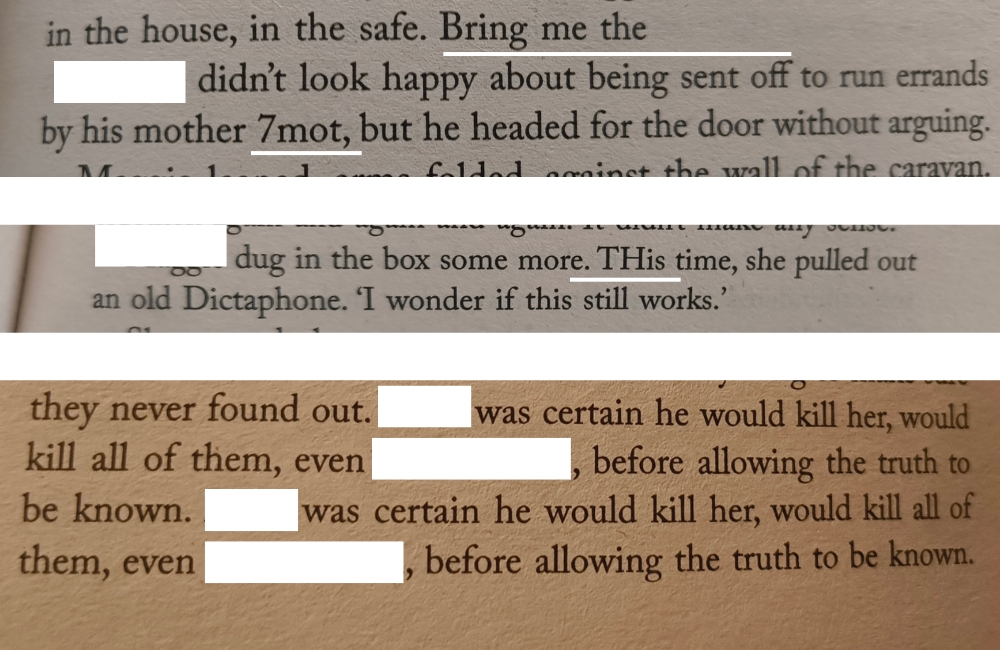
This book was clearly not proofread. From the first chapter to the second-last page, there were so many errors that I checked to see if the author had self-published the novel. I was surprised to see it was published by Harper North, an imprint of Harper Collins. It is a publisher that champions writers who live in the northern parts of the UK who write novels set in the north.
What a terrible disservice to champion authors and locations in such a lovely way, only to produce such poor quality. If I were the author, I’d be livid.
Would I Recommend the Book?
Sadly, no.
As much as I would love to find a new writer to follow, I don’t think this novel sold me on this series. It’s really not bad, but I didn’t connect with any of the characters, and the ending let me down.
Final Thoughts
Because I met the author, and because I liked the idea of a novel set in Orkney, I wanted to love this book, but it wasn’t to be.